Casey's Pawns - Victoria & Albert Museum
Date:
2004
Ref:
2051
Materials:
Lambda colour photograph backed on Dibond (Each photograph is an edition of 7 + 3AP)
Dimensions:
120 x 180 cm
Exhibition history:
2004 Victoria & Albert Museum London, UK
Courtesy:
Lucy + Jorge Orta
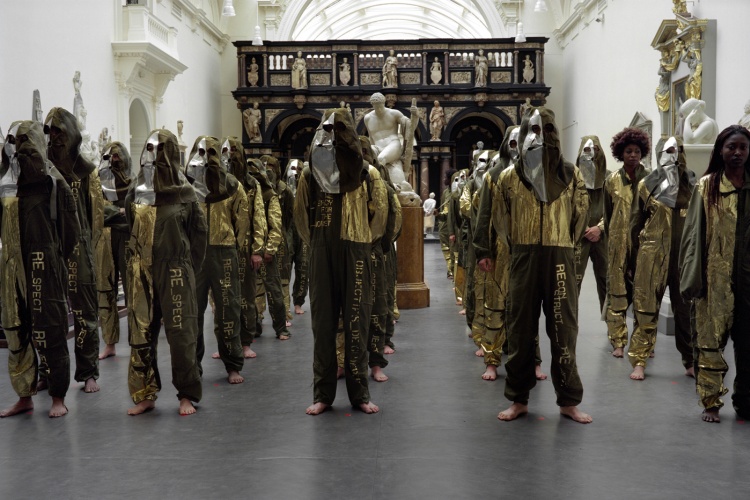
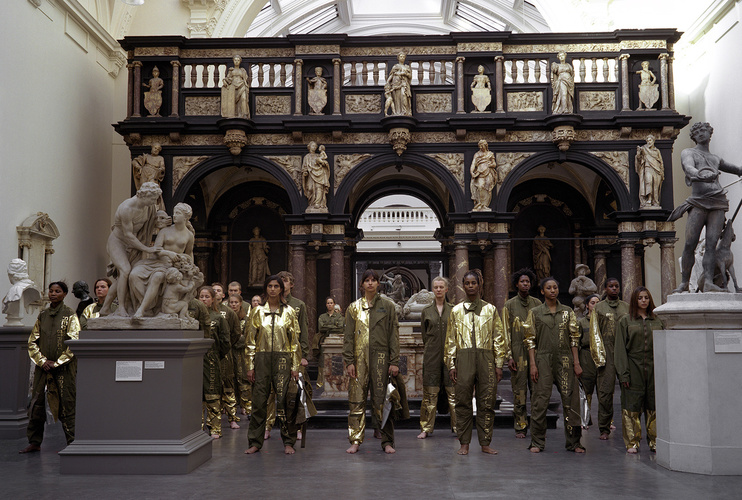
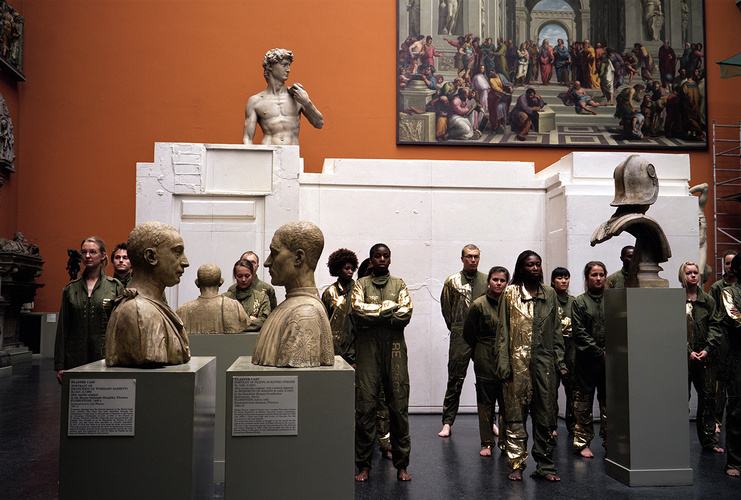
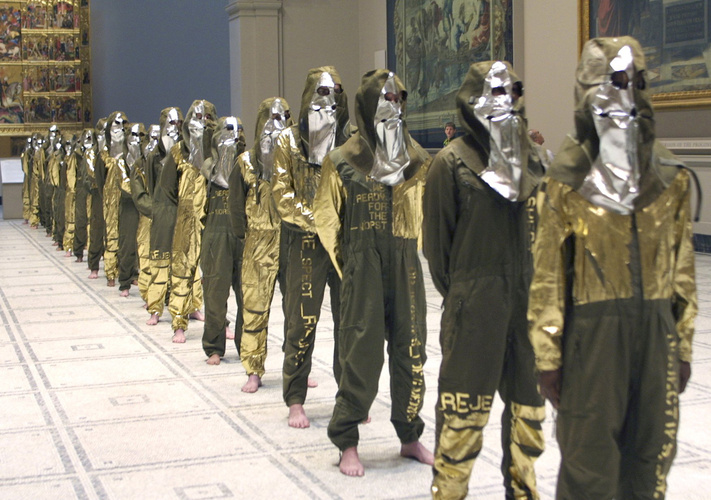
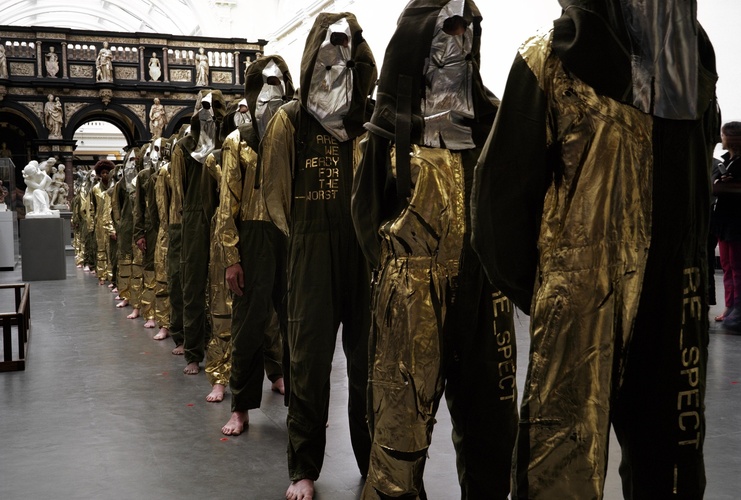
Casey's Pawns, commissioned Victoria & Albert Museum, was a performance staged on 25 June 2004, just days before the formal transfer of sovereignty to the Iraqi Interim Government. In response to the escalating conflict in Iraq and the first assault on the city of Fallujah, Lucy Orta invited fifty performers to take part in a silent demonstration for peace. The title refers to General George W. Casey Jr., who was appointed Commanding General of the Multi-National Force–Iraq in June 2004.
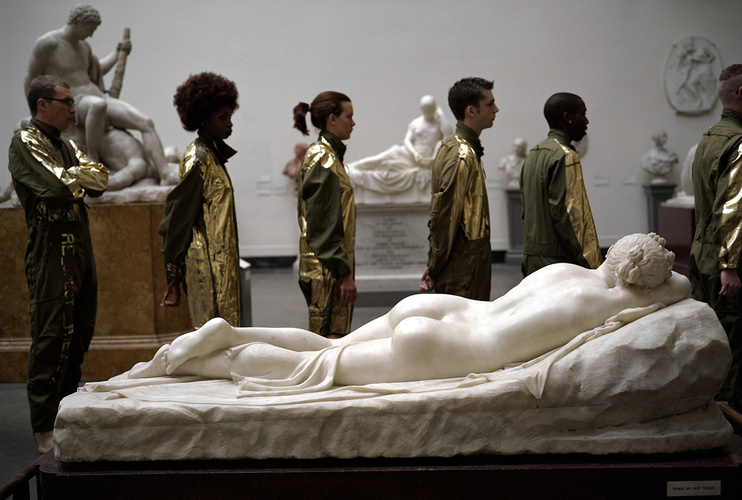
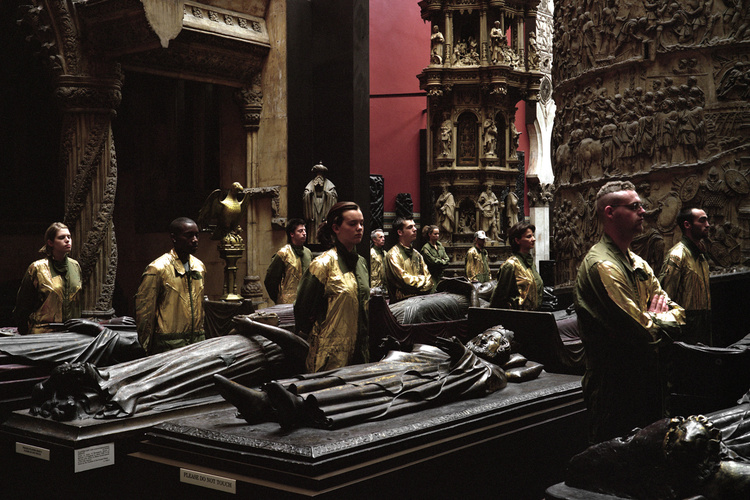
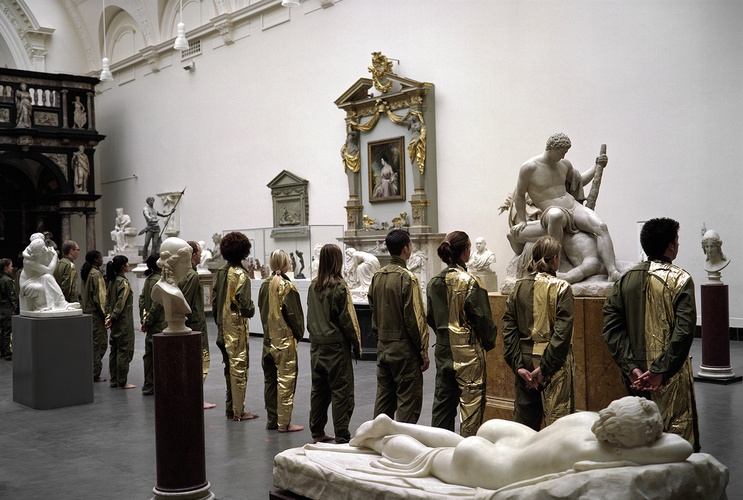
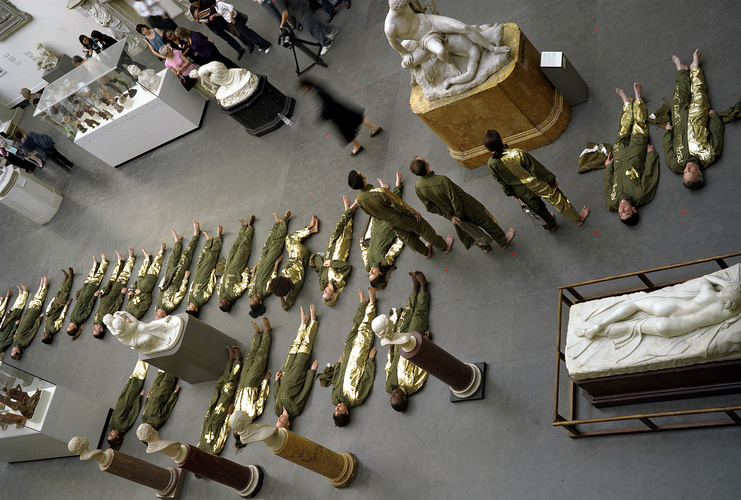
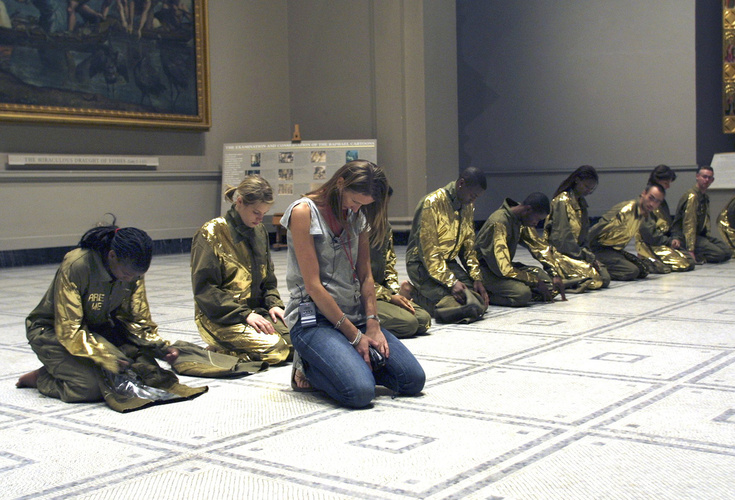
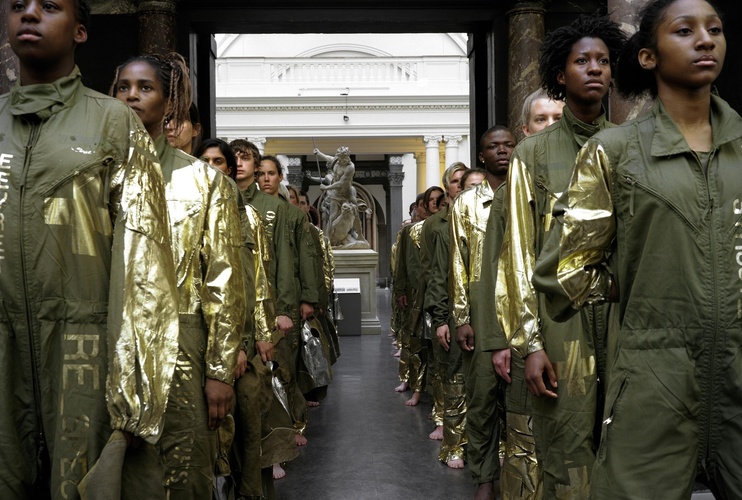
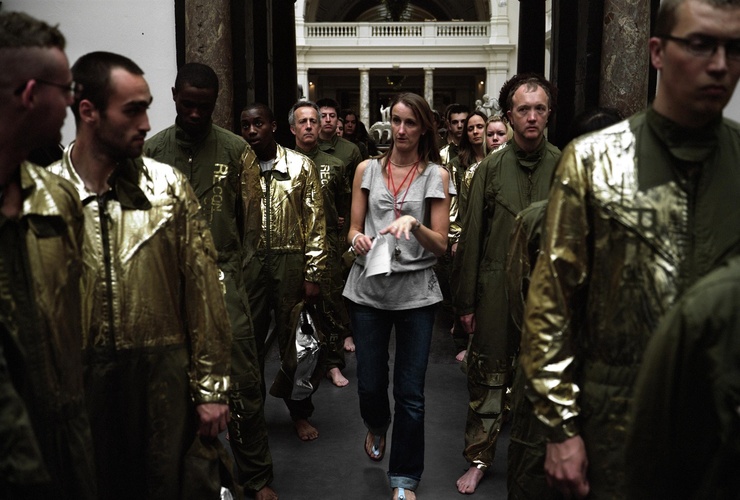
For over two hours, the performers occupied the V&A’s the Cast Courts, Raphael Court and Medieval & Renaissance galleries in formations choreographed by Lucy. Surrounded by monumental casts, tombs, sepulchres, religious imagery and trophies of historical battles and conflicts, the fifty motionless bodies introduced an unsettling presence into the museum’s historical collections.
Dressed in gold-printed combat suits inscribed with graphic signs, their faces concealed beneath hoods evoking those worn by prisoners of war, the performers remained silent. That prolonged silence was repeatedly broken by the shrill blast of a whistle. At each command, the figures dispersed through the galleries before reconvening elsewhere in new formations. The violence implicit in the uniforms, the anonymity of the hooded bodies and the authoritarian sound of the whistle created an uneasy dynamic of command, obedience and collective discipline. Its abrupt intrusion into the otherwise hushed museum was deliberately disturbing, collapsing the distance between violence preserved and represented through historical artefacts and a contemporary war unfolding beyond its walls.
Yet Casey’s Pawns was conceived as a silent protest for peace. Its silence was not passive, but a refusal to reproduce the rhetoric and spectacle of war. Against the visual and sonic language of military authority, the stillness of fifty bodies created a space for witnessing and reflection. The performers could be read simultaneously as soldiers, prisoners, casualties and anonymous citizens; their repeated gathering and dispersal transformed the military formation into an ambiguous image of collective vulnerability and solidarity. Through this tension, the performance sought to turn the symbols and mechanisms of violence and control into a call for peace.
For further information: Curator Dr Shaun Cole, V&A Late Night. Interview with Christabel Stewart for SHOWStudio. Performance documented by Roman Coppola.