Casey's Pawns - Fallujah
Date:
2007
Matériaux:
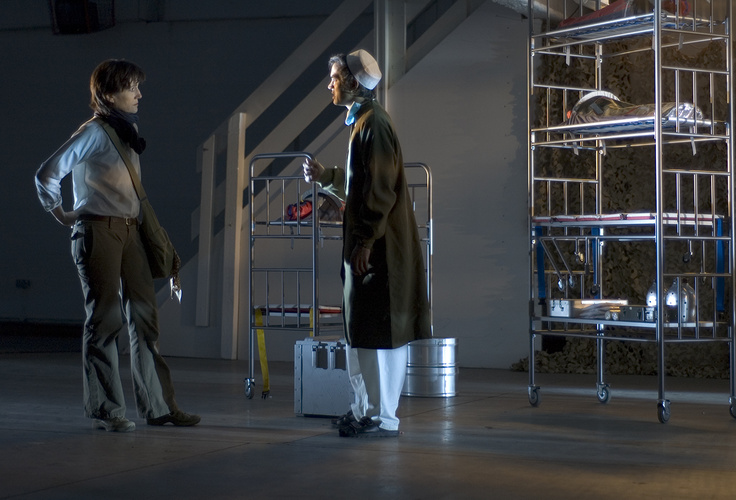
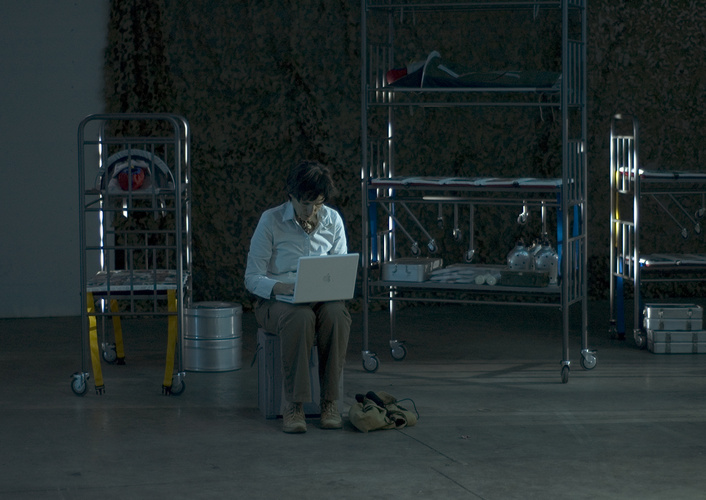
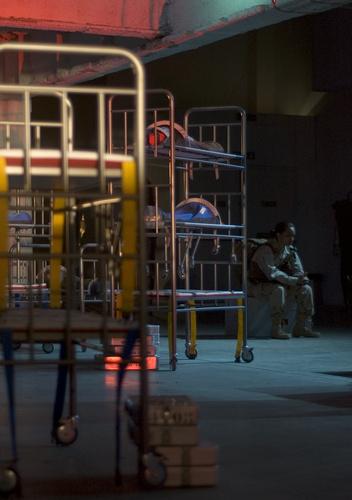
Installation of various artworks for the play 'Fallujah' written and directed by Dr Jonathon Holmes
Dimensions:
Various
Exhibition history:
2007 Fallujah – Auszug 01, Context #4: Cover, Hebbel am Ufer, Berlin; The Old Truman Brewery, ICA off-site, London, UK
Courtesy:
Lucy + Jorge Orta
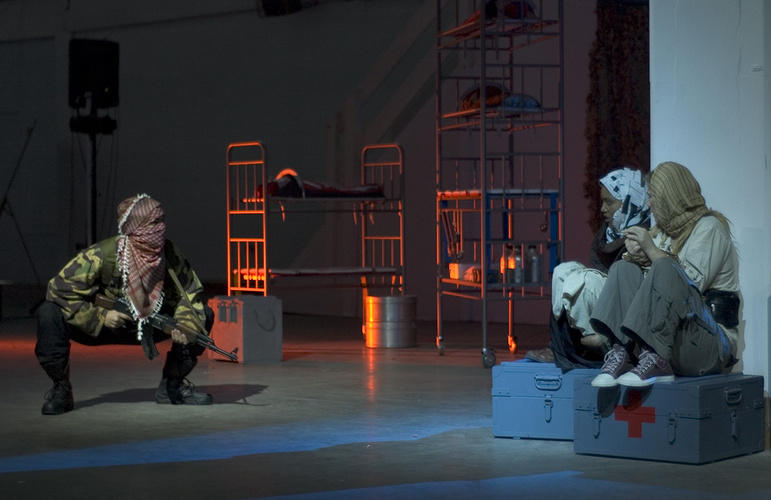
In 2007, Lucy + Jorge Orta collaborated with playwright Dr Jonathan Holmes to create the set design for Fallujah, a verbatim play confronting the human consequences of the three military assaults on the Iraqi city in 2004.
Holmes developed the script from testimonies gathered from Iraqi civilians, NGO workers, politicians, US and UK military personnel, and journalists who witnessed or were involved in the events, alongside unpublished evidence collected by Nobel Peace Prize nominee Dr Scilla Elworthy of Peace Direct.
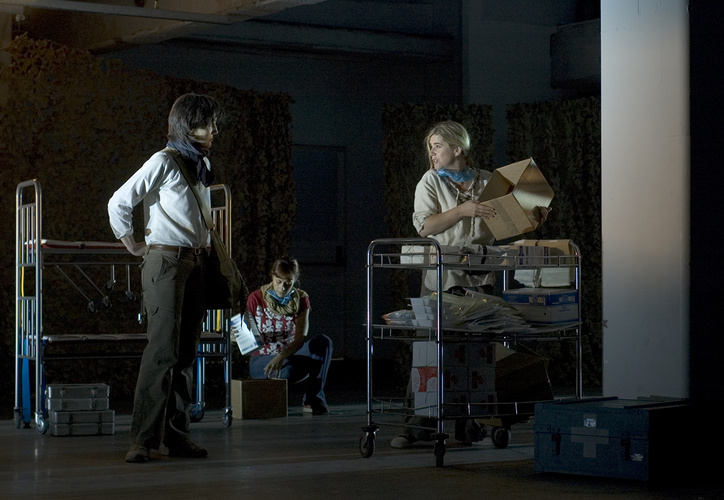
Responding to these accounts, Lucy + Jorge Orta conceived the set as an immersive, walk-through installation in which the audience moved through an environment bearing traces of conflict and emergency. Sculptural elements included miniature hospital beds, reconditioned stretchers and camp beds, ambulances, and other works created by the artists in response to the invasion of Iraq. Rather than serving as a backdrop, the installation brought the material and bodily consequences of conflict into direct proximity with the audience, creating a spatial framework through which the testimonies could be encountered.
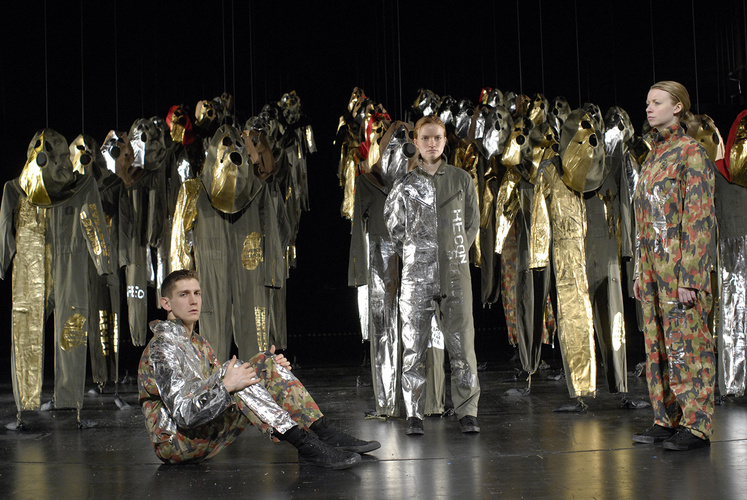
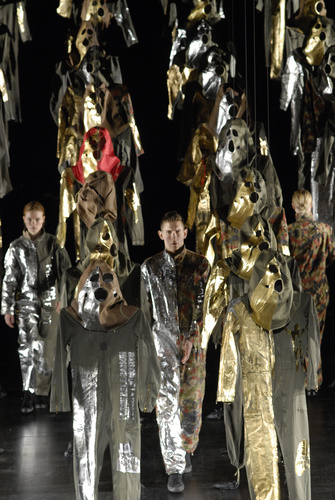
In one scene, the actors wore the artists’ gold-printed combat suits, first created for Casey’s Pawns, commissioned by the Victoria and Albert Museum and staged on 25 June 2004, just days before the formal transfer of sovereignty to the Iraqi Interim Government. Fifty performers occupied the museum galleries in a silent demonstration for peace, their faces concealed by hoods associated with prisoners of war. Inscribed with graphic signs, the combat suits subverted the visual language of military uniform and violence into a collective statement of protest and peace. Three years later, their reappearance in Fallujah brought this earlier intervention into direct dialogue with the eyewitness testimonies at the heart of Jonathan Holmes’s play.
“It became clear that not only the story of Fallujah needed to be told, but also the stories of the people doing the telling. I wanted the accounts of witnesses to some of the most serious crimes committed during an atrocious war to be heard by audiences unaware, in the main, of those crimes. It seemed that only live performance could fully capture the simple symmetry of this dynamic. Horror has become a formula; I wanted to restore a sense of immediacy. I turned the testimonies I had gathered verbatim into a play... Fallujah.” — Jonathan Holmes, 2007
For further information: The Guardian, New York Times.